
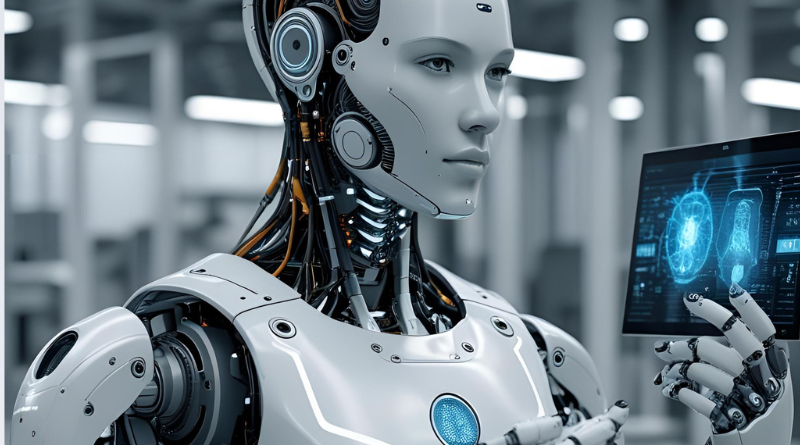
Since the spread of artificial intelligence, the fear of it taking over human jobs has become a contemporary concern.
In a short period of time, AI has replaced many humans in jobs such as translation, writing, teaching, and customer service.
We now have robot chefs, robots specializing in complex surgical procedures, and robots capable of performing in vitro fertilization in assisted reproductive centers.
Not to mention factories entirely run by AI-powered robots.
Will AI replace humans within the next three years? This is what we will explore together in the following paragraphs.
Changes in the Labor Market Caused by Artificial Intelligence
Artificial intelligence is revolutionizing the labor market, replacing humans in some jobs, with the potential to create new jobs that require different human skills.
Jobs Significantly Impacted by AI
Jobs that have been replaced or significantly impacted by AI are typically repetitive, rule-based, and are most susceptible to automation by AI. The most notable of these jobs are:
- Data Entry and Administrative Tasks:
- AI can process and organize massive amounts of data more quickly and accurately than humans. This includes tasks such as document scanning, sorting information, and data entry.
- Manufacturing and Assembly Lines:
- Robots and AI are widely used in factories to perform repetitive physical tasks such as welding, assembly, packaging, and quality control.
- Customer Service and Support:
- Chatbots and automated response systems have become common in customer service, answering common inquiries and providing basic support.
- Accounting and Bookkeeping:
- AI can automate tasks such as invoicing, recording transactions, and preparing basic financial reports.
- Bank tellers:
- With the proliferation of self-service payment systems and digital banking, demand for traditional bank tellers is declining.
- Travel agents:
- With the availability of online booking platforms and artificial intelligence that searches for the best deals, the role of traditional travel agents is diminishing.
- Truck drivers and delivery drivers:
- Although still in development, autonomous driving technologies pose a long-term threat to these jobs.
- Basic content creation:
- AI can generate simple news texts, financial reports, or even some types of marketing content.
Job market forecasts for the next three years, through mid-2028
Rapid transformations are expected in the job market. The following are the most prominent forecasts:
Continued automation of routine and repetitive tasks:
More jobs that rely on predictable tasks, office work, and administrative work will see increased automation. This doesn’t necessarily mean that jobs will disappear entirely, but rather that they will shift so that humans focus on more complex and creative aspects.
Creating new jobs related to artificial intelligence:
The spread of artificial intelligence will lead to the emergence of new jobs that require specialized skills in developing, deploying, and maintaining AI systems. These jobs include:
- AI and machine learning engineers: to design, develop, and train AI models.
- Data scientists and data analysts: to collect, analyze, and interpret the data needed to feed AI systems.
- AI ethics and governance specialists: to ensure that AI is used responsibly and ethically.
- UX/UI specialists: to design seamless and interactive user experiences with AI systems.
Increased Demand for Unique Human Skills:
There will be an increased demand for jobs that require skills that are difficult for AI to replicate. These skills include:
- Emotional intelligence and empathy in healthcare, education, counseling, and psychotherapy.
- Critical thinking and complex problem-solving in senior management, scientific research, and complex legal professions.
- Creativity and innovation in the arts, design, creative writing, and research and development.
- Social and communication skills in leadership, team management, and customer service, which require deep human interaction.
The Importance of Upskilling and Reskilling
Continuous learning, upgrading existing skills, and acquiring entirely new ones will be critical for individuals to remain competitive in the job market. Companies and governments will need to invest in training programs to prepare the workforce of the future.
Accordingly, we expect the following to occur:
- The nature of some jobs will change rather than disappear: Many jobs will not disappear entirely, but the nature of the tasks required will change. For example, accountants may use AI tools to automate data entry and basic auditing tasks, focusing their time on financial analysis and strategic consulting.
- Increased productivity and economic growth: The integration of AI is expected to significantly increase productivity across various sectors, potentially stimulating economic growth.
- The impact will vary across sectors and countries: Some sectors will be more affected than others, and the extent and speed of AI adoption will vary between countries based on infrastructure, investments, and government policies.
Crushing Defeat for AI in Chess
Recently, some modern AI systems, such as ChatGPT, failed to defeat an old version of chess running on the Atari 2600 dating back to 1979.
This incident generated significant interest and highlighted some important points about AI capabilities:


AI is not “general intelligence”:
Modern AI programs, such as large language models (LLMs), are designed to be “general” in their linguistic abilities—that is, they are excellent at understanding and generating text, conversing, and even offering simple advice. However, this does not mean they possess “intelligence” in the general human sense that allows them to excel at all tasks automatically.
Specialization vs. Generalization:
Old chess programs, such as those on the Atari 2600, were precisely and specifically programmed to play chess. These systems are designed with powerful search algorithms (such as minimax) and accurate assessments of board state, making them highly effective at their specific task, even if their computational capabilities are primitive compared to modern systems.
Environmental and Representation Limitations:
When trying to play an old Atari game, modern AI systems struggle to interpret the game’s simple, pixelated visual interface and translate it into an accurate understanding of the chessboard state. This problem of “visual context understanding” is one of the challenges AI continues to face.
Memory and Game State:
Unlike specialized chess programs, which maintain an accurate memory of the current game state and piece movements, large language models can struggle to accurately track this “changing state,” leading to illogical errors during play.
Conclusion:
While AI has demonstrated exceptional chess capabilities for decades, such as Deep Blue’s 1997 victory over Garry Kasparov, the recent failure of some modern models to defeat an old Atari chess game confirms that:
- Specialized AI, such as powerful chess programs, differs from general-purpose AI, such as large language models.
- Despite its sophistication, AI still has weaknesses and limitations, particularly when it comes to understanding complex visual context or maintaining accurate memory of a dynamic situation in unfamiliar environments.
- These incidents remind us that AI’s “intelligence” does not always match human intelligence, and that its understanding of reality and tasks may be quite different.
This does not diminish the capabilities of AI in general, but it does highlight the subtle differences in how these systems are designed and their ability to handle different types of problems.
Also read:
- the-age-of-ai-agents
- a-chinese-humanoid-robot-cooks-using-virtual-reality
- brain-computer-interfaces-when-telepathy-becomes-a-technological-reality