
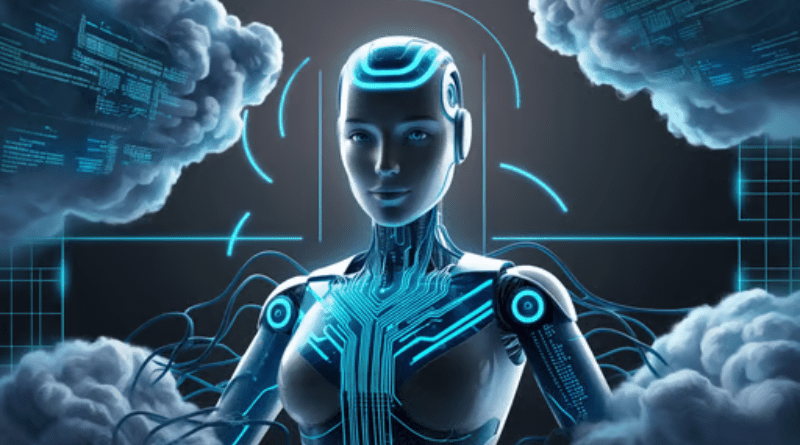
Generative AI is a type of AI capable of generating new and innovative content, such as text, images, music, video, and even code.
Unlike traditional AI, which focuses on analyzing or predicting existing data, generative AI has the ability to “think” creatively and produce things that never existed before.
This is due to the massive database it relies on to understand and learn from patterns, and the complex neural networks it uses to generate new data similar to the data it was trained on.
How Does Generative AI Work?
Generative AI models rely on massive amounts of data to learn. If the goal is to generate text, the model is trained on billions of different texts to learn grammar, writing styles, and different contexts. After training, the model is able to:
- Receive prompts, such as “write a poem about space” or “create an image of a bird in a tree.”
- Connecting What It Learns: The model connects the different concepts it was trained on, such as birds and trees, and their characteristics.
- Creating New Content: The model generates unique content, even if it has never seen anything similar before.
Applications of Generative AI
Generative AI has broad and diverse applications in various fields, including:
Text and Conversational Generation:
- Generative AI can generate articles, stories, emails, and documents.
- Developing chatbots and virtual assistants capable of conducting natural conversations and providing accurate answers.
- Summarizing long texts and translating languages.
Image and Video Creation:
- Create artistic images, graphic designs, and illustrations from text descriptions.
- Create videos and animations, and add special effects.
- Enhance medical images and create new images to track disease progression.
Music and Sound Creation:
- Create original music tracks in a variety of styles.
- Create natural human voices for voice assistants and audio narrations.
Create Code:
- Assist developers in writing code, debugging, and testing applications.
- Create technical documentation and user manuals for software.
Industrial Design and Art Creation:
- Create new designs for complex products and structures.
- Assist in creative design processes in fields such as fashion and game design.
Healthcare and Pharmaceuticals:
- Accelerate drug discovery and development by creating new molecular structures.
- Improve disease diagnosis and customize treatment plans for patients.
Generative AI Models
Generative AI is a revolutionary field focused on creating new and unique content. Models vary in their specializations and capabilities, the most prominent of which are:
Large Language Models (LLMs)
These models are specifically designed to understand and generate human-generated text. They are trained on massive amounts of text data (books, articles, websites, conversations) to learn grammar, context, grammatical patterns, and factual information.
Their advantages:
- Generating coherent and relevant texts: They can write articles, stories, poems, emails, code, and more.
- Understanding conversational context: They can follow complex threads in conversations and provide relevant answers.
- Translation and Summarization: They can translate texts between languages and summarize long documents efficiently.
- Question Answering: They can answer a wide range of questions based on their extensive knowledge.
- Creative Writing: They can mimic different writing styles and generate creative content.
Notable examples:
- ChatGPT (from OpenAI): Known for its ability to conduct natural conversations and generate creative texts.
- Claude (from Anthropic): Focuses on security and assistance, and excels at processing long inputs.
- Gemini (from Google AI): Multimodality. This is its most important feature. Unlike older models that specialized in one type of data (text only, images only), Gemini can understand and integrate information from different types of data simultaneously, It can process text, images, videos, audio, and code together.
Text-to-Image Models:
These models specialize in converting textual descriptions (prompts) into unique, realistic, or artistic visual images. They have revolutionized the fields of design and artistic creation.


Their advantages:
- Unlimited visual creativity: They can generate images of almost anything that can be described in text, from real-life objects to imaginary scenes.
- Fine customization: They allow users to specify fine details such as artistic style, lighting, composition, and materials.
- Speed and Efficiency: Generates high-quality images in seconds or minutes, saving significant time and effort compared to hand-drawing or traditional photography.
- Stimulates Inspiration: Helps artists and designers explore new ideas and visualize complex concepts.
Notable Examples:
- DALL-E (from OpenAI): One of the first models to demonstrate impressive capabilities in generating images from text.
- Midjourney: Known for producing high-quality, aesthetically pleasing artistic images.
- Stable Diffusion: An open-source model available to everyone, which has allowed for its widespread adoption and the development of numerous applications.
Text-to-Video Models
A recent development of these models, they can generate short videos from textual descriptions, complete with motion and dynamic objects. They are still in their early stages compared to text and images, but they are very promising.
Advantages:
- Transforming Ideas into Motion: The ability to visualize animated scenes from simple textual descriptions.
- Significant Savings of Time and Money: The ability to quickly produce raw video footage without the need for filming equipment or large teams.
- Storytelling capabilities: Opening new horizons for directors and content creators to create unique animated scenes.
Notable examples still in limited or experimental development:
- Sora (from OpenAI): Demonstrated impressive capabilities in generating realistic and complex videos from textual descriptions.
- Lumiere (from Google AI): Focuses on generating realistic and high-quality videos.
Code Generation Models
These models are designed to assist programmers by generating code snippets, completing code, debugging, or even writing entire functions based on a textual description of the desired function.
Their benefits:
- Increased developer productivity: Speeds up the programming process and reduces the time spent writing repetitive or routine code.
- Reduced errors: Helps detect and debug errors in code.
- Learning new languages: Can help programmers learn syntax in languages they don’t fully master.
- Documentation generation: Automatically generates documentation for code, making it easier to understand and maintain.
Notable examples:
- GitHub Copilot (powered by OpenAI Codex): A code completion tool for programmers that suggests solutions.
- Amazon CodeWhisperer: A similar tool that provides code recommendations based on comments or existing code.
Music and Audio Generation Models
These models are capable of generating original music in various styles, or generating text-to-speech voices or sound effects from text descriptions.
Their features:
- Automated Music Creation: Generating new and unique music for use in games, movies, or as background audio.
- Realistic Human Voices: Generating highly natural voices for use in voice assistants, audiobooks, or advertising systems.
- Voice Personalization: The ability to modify voice characteristics such as pitch, speed, and accent.
Notable examples:
- Google’s MusicLM: Generates music from text descriptions or even melodies.
- Meta’s AudioGen: Generates sound effects from text descriptions.
- Text-to-Speech models (like those used in Google and Apple assistants): Convert text to speech.
The Future of Generative AI
The future of generative AI looks bright and full of limitless possibilities. We will witness incredible advances in its ability to generate more realistic, creative, and personalized content across text, images, video, and audio. These models will become embedded in our daily lives and businesses, enhancing productivity, unlocking new avenues for creativity, and accelerating innovation in countless fields, from medicine and science to art and education.
Also read:
- should-you-buy-bitcoin-now-or-is-it-too-late-in-2025
- the-age-of-ai-agents
- a-leak-reveals-the-iphone-17s-battery-capacity-predicting-radical-changes